
How to Manage Renovation Delays in Singapore: A Practical Guide

Updated: 18 hours ago
What if the stalled task isn’t the real threat to your opening date, but the work waiting behind it? If you’re looking for practical guidance on how to manage renovation delays Singapore businesses face, start by finding out what has stopped and which upcoming tasks depend on it.
A delay can put a handover, relocation or opening plan under pressure. It’s also hard to act when explanations are unclear or contractors, landlords, building management and consultants aren’t aligned. Pushing ahead with dependent work can create rework, while stopping everything may cause unnecessary disruption.
This guide explains how to identify the cause and schedule impact, protect the remaining programme, and agree on documented next steps with clear responsibilities. It also covers how to assess which work can continue while a delayed activity is resolved. The focus is practical: identify dependencies, monitor the critical path and maintain oversight without making rushed decisions.
Table of Contents
Renovation delays in Singapore: identify the issue before reacting
How renovation schedules work: dependencies, sequencing and the critical path
Renovation delay recovery options: compare resequencing, resourcing and scope changes
A practical action plan for managing renovation delays in Singapore
How JM & SONS coordinates commercial renovation work and recovery planning
Renovation delays in Singapore: identify the issue before reacting
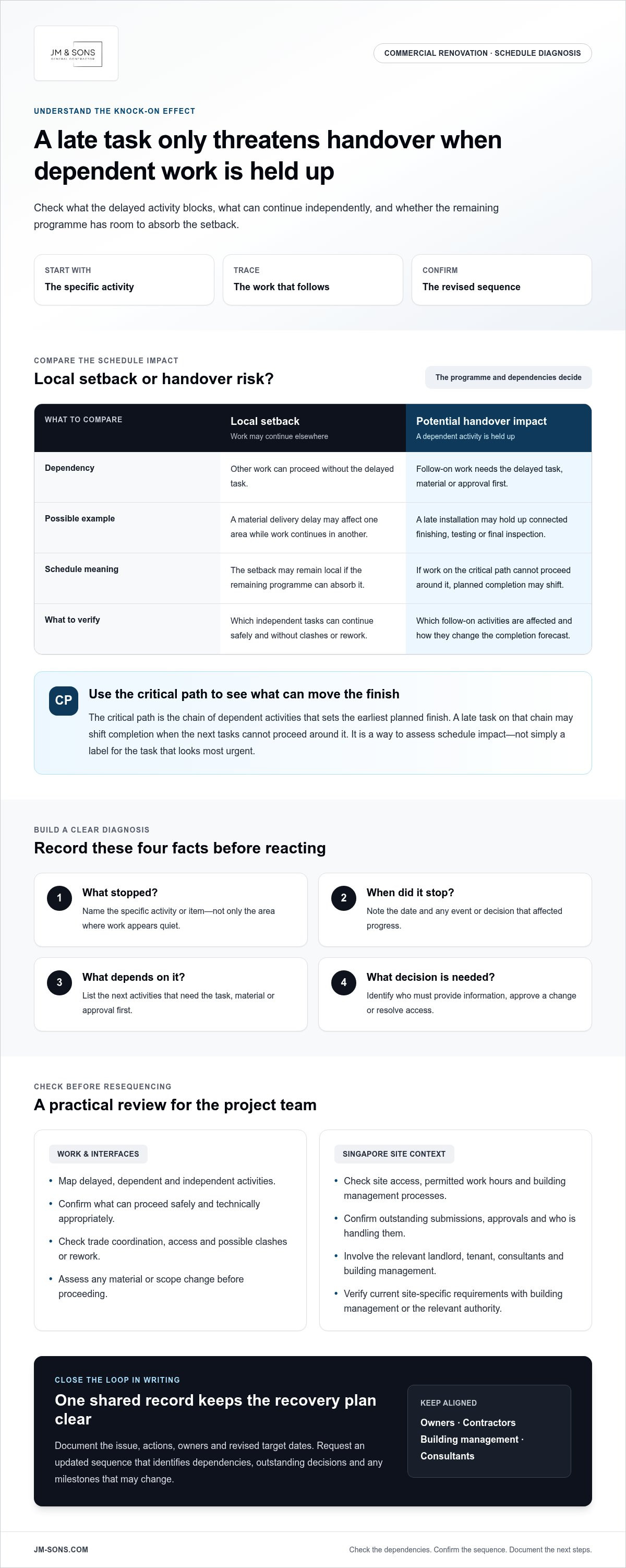
A task finishing late doesn’t automatically mean the handover date will move. The key question is whether other work depends on that task and whether the remaining programme has room to absorb the setback. A delayed material delivery, for example, may affect only one area if other work can proceed. If installation must happen before testing or final inspection, the same delay could affect the planned handover.
Commercial projects can be affected by unresolved approvals, material availability, restricted site access, pending decisions or trade sequencing. The practical impact depends on the scope, site and activities that follow. An opening date, relocation plan, daily operations or lease milestone may be affected, but check the programme before assuming that it will be.
Before deciding what to do, record four facts:
What stopped? Identify the specific activity or item, not just the area where work appears quiet.
When did it stop? Note the date and any event or decision that affected progress.
What depends on it? List the next activities that need this task, material or approval first.
What decision is needed? Identify who must provide information, approve a change or resolve an access issue.
How to tell whether a setback affects the handover date
Compare the affected activity with the latest programme, then trace the work that follows it. Separate tasks that can continue independently from those that need the delayed item first. For example, a delay in one zone may not prevent work elsewhere, while a late installation could hold up connected finishing or testing. A dependency map informed by the Critical Path Method can help make these links visible.
Ask the project team to explain the revised sequence, what can proceed safely and whether the planned handover is affected. The explanation should connect the cause to specific dependent activities, rather than offer a new date without showing how it was assessed.
Singapore commercial factors to include in the diagnosis
Check whether site access, permitted work hours or building management processes are affecting the activity. A work sequence may depend on access arrangements or a submission process, so establish what is outstanding and who is handling it. Where relevant, include the landlord, tenant, consultants and authorities in the discussion instead of treating the delay as a contractor-only issue.
Clear coordination is a practical starting point when managing renovation delays in Singapore. Confirm current site-specific requirements directly with building management or the relevant authority, as these can depend on the building and proposed work. Then ask the project team to state the cause, schedule impact and next decision in writing. This gives everyone a shared basis for planning and helps avoid rushed changes that create further disruption.
How renovation schedules work: dependencies, sequencing and the critical path
A commercial renovation programme is more than a list of tasks and target dates. It shows how one activity enables another. For example, a design decision may be needed before materials can be ordered, while site access may be required before a trade can begin. These are project-specific examples, not a fixed sequence for every fit-out.
The critical path is the chain of dependent activities that sets the earliest planned finish for the project. If one activity on that chain runs late and the next tasks can’t proceed around it, the planned completion may shift. If other work can continue without causing clashes or rework, the setback may remain local. The critical path is a way to understand schedule impact, not simply a label for the task that looks most urgent.
Dependencies can arise between design approvals, procurement, access arrangements and trade sequencing. For instance, custom carpentry installation may depend on preceding site works and coordinated measurements—a sequencing discipline shared across commercial spaces as well as home renovations handled by FT2 Interior Design. A delay in one area doesn’t automatically stop finishing in another, but the team should confirm that proceeding elsewhere is safe and technically appropriate. Workarounds must not bypass required approvals, building rules or coordination between trades.
Which work can continue while another activity is delayed?
Ask the project team to map the delayed activity against dependent and independent work. This may show that finishing in one zone can proceed while carpentry for another is pending, or that a later trade must wait until installation is complete. Treat these as options to assess, not instructions to move work ahead regardless. Confirm that access, interfaces and relevant approvals are in order before changing the sequence.
How to assess the knock-on effect
Request an updated sequence in writing. It should identify dependencies, who owns each outstanding decision and which milestones may change. A late task alone doesn’t show that the overall completion forecast has moved. Ask the team to identify affected follow-on activities and explain how they change the forecast. For broader coordination context, JM & SONS General Contractor Pte Ltd’s commercial project management services bring project activities and stakeholders into a coordinated process.
Payment arrangements can also affect procurement or the scheduling of work, depending on the project agreements. A report on payment delays impacting Singaporean construction projects discusses this issue in the local construction sector. For your programme, focus on the specific dependency: whether a payment, instruction or approval is holding up a material release or planned activity.
A practical part of managing renovation delays in Singapore is distinguishing what is late from what is now forecast to finish late, and keeping the reasons visible. If your programme needs a clearer dependency review, you can share the current renovation schedule with JM & SONS General Contractor Pte Ltd.
Renovation delay recovery options: compare resequencing, resourcing and scope changes
Once the cause and schedule effect are understood, compare recovery options against the work that remains. A change may help one activity but create new dependencies elsewhere. Ask the project team to explain the benefit, what must happen first and the risks before agreeing to a revised approach. No option guarantees a particular amount of time saved.
Use this comparison to guide the discussion. Each approach depends on the project scope, site conditions and any required approvals.
Option
May help when
Coordinate before proceeding
Resequencing
Independent tasks can move forward while another activity is held up.
Check access, trade interfaces, safety and whether the revised order could cause rework.
Additional coordination or resourcing
A task can progress with clearer instructions, coordination or suitable added resources.
Confirm the people, materials, work area and supervision needed, and whether other trades may be affected.
Alternative procurement
A delayed item is important to the programme and a suitable alternative may be available.
Review specification, design fit, availability, cost or scope implications, and applicable approvals.
Scope change
The original scope or decision needs reconsideration to address a project constraint.
Record the proposed change, its impact, the decision-maker and any approvals before implementation.
When resequencing or flexible work hours may help
Resequencing is worth considering when separate areas or activities can proceed without conflicting with the delayed work. The revised plan should show who is working where and how trades will hand over. Night work may also provide a scheduling option, subject to building rules, site conditions and any required approvals. JM & SONS can operate 24/7, including night work, but the workable arrangement depends on the project and building requirements.
When to reconsider procurement or scope
First establish whether the delayed material or decision actually holds up dependent work. If it does, document the proposed alternative, any cost or scope implications, the person responsible for approval and applicable submission or building requirements. Don’t order or install a substitute on assumption alone. The relevant parties must agree before the change is put into effect.
When deciding how to manage renovation delays in Singapore, choose a recovery option that addresses the actual constraint without creating a new one. Keep the comparison and decision in writing, then reflect the agreed action in the programme. This gives the team a clear basis for coordination without promising an unsupported recovery date.
A practical action plan for managing renovation delays in Singapore
A useful recovery plan turns an unclear setback into a sequence of decisions. Keep the project team working from one current record so the cause, schedule impact and agreed responsibilities are visible to the people who need to act.
Document the issue. Record the affected work, when the delay arose, the cause as currently understood and any supporting information, such as a pending instruction or delivery update. Mark what is known and what still needs to be established.
Assess dependencies. Identify the next activities that rely on the delayed work and which parts of the project may proceed independently. Ask the team to explain whether the setback affects a milestone or the overall completion forecast, and why.
Agree on practical actions. Confirm the action, the person responsible and any decision or approval needed before work changes. Include relevant owners, landlord, building management, consultants or authorities where their input is required.
Update the programme. Record the revised sequence and target dates for affected activities. Keep the previous plan available for reference so the reason for changes remains clear and the team can track whether recovery actions are working.
Monitor and review. Set a regular point to check progress against the agreed actions. If an assumption changes, update the record and programme rather than relying on informal messages or outdated dates.
What to document at each delay review
Use one concise meeting note or project record. Include the affected work, known cause and supporting evidence, the decision needed, its owner, agreed actions, dependencies and revised target dates. Share it with the relevant project stakeholders and correct misunderstandings promptly. If responsibility or contractual consequences are disputed, review the signed contract and seek appropriate professional advice rather than treating a project note as a legal conclusion.
How to protect business operations during recovery
State which areas, routes or activities must remain available for staff, customers or building operations. Identify access-sensitive or noisy tasks and coordinate their timing with building management and affected occupants. Any revised working arrangement must fit the site’s rules and the approved work plan. For a wider workplace project, JM & SONS General Contractor Pte Ltd’s office renovation and fit-out work involves coordinating construction with project requirements.
The practical method for managing renovation delays in Singapore is to keep decisions traceable, responsibilities clear and operational needs in view. A written record gives each stakeholder the same reference point when the schedule changes.
If you’re reviewing a delayed commercial renovation, send JM & SONS General Contractor Pte Ltd your floor plans or site photos on WhatsApp to discuss the project and its remaining work.
How JM & SONS coordinates commercial renovation work and recovery planning
A renovation delay needs a clear response, not a promise that every lost day can be recovered. JM & SONS is a Singapore commercial renovation and fit-out contractor. The team coordinates construction work with owners, landlords, building management, consultants and authorities where the project requires it. This helps keep decisions, site requirements and work sequencing visible as the remaining programme is reviewed.
When considering how to manage renovation delays in Singapore, focus on what has changed, who needs to act and which work can move ahead responsibly. The appropriate response depends on the project scope, access arrangements and applicable approvals. No recovery plan should be treated as a guaranteed completion date.
In-house capabilities and clear project coordination
JM & SONS has in-house carpentry, hacking, tiling and project teams, supported by a 10,000 sqft carpentry workshop. This direct involvement helps the team coordinate its work and discuss sequencing across related activities. The company can operate 24/7, including night work and flexible scheduling, subject to site and building requirements. These capabilities allow options to be considered, but don’t guarantee a specific schedule recovery.
Clear scope information is just as important. Itemised work descriptions, quantities and specifications give the project team a shared reference when reviewing a change or resolving a question. If a proposed adjustment affects materials, finishes or responsibilities, the relevant parties can assess what has changed and document their agreement before implementation.
Experience and a practical next conversation
JM & SONS was established in 1990 and has 35+ years of experience, with 200+ commercial projects completed. The company is registered with BCA, BizSafe Level 3 certified and fully insured for commercial construction. These credentials are relevant, but each project still needs to be assessed against its scope, site conditions and coordination requirements.
For a commercial project discussion, the current programme, floor plans, site photos and any project checklist can help clarify the work and outstanding decisions. JM & SONS’ commercial renovation and fit-out services cover project coordination alongside construction and procurement. Sharing relevant documents can make an initial discussion more specific without assuming the schedule or solution in advance.
If you’re reviewing a delay or planning the remaining works, you can send floor plans, site photos or a project checklist on WhatsApp for a practical conversation with JM & SONS.
Take the next step with a clear view of the remaining work
A delay doesn’t have to leave your team guessing. Bring the current programme, unresolved decisions and business operating needs into one discussion. That gives everyone a clearer basis for weighing options and agreeing what should happen next, without assuming that every late task has changed the handover date.
If you’re considering how to manage renovation delays in Singapore, keep the focus on a practical, documented plan. Make sure the people responsible for decisions understand what the remaining work depends on and what any proposed change means for the site.
JM & SONS General Contractor Pte Ltd supports commercial renovation and fit-out projects with coordination tailored to the work and site requirements. To discuss your situation, start a WhatsApp conversation with your floor plans or site photos ready. A clear starting point can help turn uncertainty into a considered next step.
Frequently Asked Questions
Is every renovation delay the contractor’s responsibility?
No. Responsibility depends on the cause, project records and terms agreed for the work. A contractor may be responsible for an issue within its planning or execution, while a late client decision, restricted access or outstanding approval may involve other parties. Establish what happened and when before assigning responsibility. If the parties disagree, review the contract and seek appropriate professional advice.
Can commercial renovation work continue while one activity is delayed?
Sometimes. Work in a separate zone may be able to proceed while a delayed task is resolved, provided the areas, trades and activities are properly coordinated. For example, a tenant may be able to maintain access to an unaffected part of the premises while work continues elsewhere. The project team should assess site conditions, safety and any impact on occupants before changing the work arrangement.
What should I include in a renovation delay update?
Include the date of the update, the affected work, the latest confirmed information and any decisions still outstanding. Identify who is responsible for each action and when the matter will be reviewed again. If a delivery or instruction is involved, attach the relevant correspondence or record. This helps recipients distinguish confirmed facts from estimates and respond to the specific issue rather than relying on assumptions.
How do building management requirements affect renovation schedules in Singapore?
Building-specific arrangements can affect when workers enter, how materials reach the unit and which work periods are available. For example, a lift booking or restricted work window may influence the sequence for moving materials or carrying out noisy tasks. Requirements vary by property and scope. Confirm current arrangements with building management and check with relevant authorities where submissions or approvals apply.
Can changing materials or scope help recover a renovation schedule?
It may help if the delayed item is holding up dependent work and a suitable alternative can be agreed. Compare the proposed material’s specification, appearance and fit with the intended design, then establish any cost or scope implications. Get the relevant parties’ agreement and complete applicable approvals before ordering or installing a substitute. A change can also introduce new coordination steps, so assess its effect on the remaining programme first.
What happens if a renovation delay affects a lease or opening date?
Notify the relevant internal decision-makers and communicate promptly with the landlord or building management if the project affects access, occupancy or handover arrangements. Review the lease and renovation contract to understand the dates and procedures that apply to your situation. If the delay may create contractual consequences, seek advice from a suitably qualified professional. Don’t assume that an opening date or lease milestone automatically changes with the construction programme.
Should I agree to a revised handover date before the recovery plan is documented?
It’s prudent to understand the basis for a proposed date before treating it as agreed. Ask for the revised work sequence, outstanding dependencies, decision owners and assumptions behind the forecast. Clarify in writing whether the date is an estimate or a formal change to an existing agreement. If the revision could affect contractual obligations, review the relevant documents and obtain appropriate professional advice before confirming it.


Comments