
Shop reinstatement works: costs, scope and lease duties

An empty shop isn’t necessarily ready to hand back. In Singapore, shop reinstatement works return a rented retail unit to the condition required by its lease and the landlord’s handover instructions. Start planning three to six months before lease expiry to allow time to agree the scope and arrange the work.
The tenant remains responsible for meeting reinstatement obligations, even when a contractor performs the work. This can involve removing shopfront features, signage or fittings, repairing affected surfaces and coordinating building-management requirements. In a mall, access rules and permitted work hours can also shape the programme.
This guide explains what reinstatement may include, how lease clauses and mall rules affect the work, and what influences the cost. You’ll also learn how to plan the handover and how a commercial reinstatement contractor can coordinate the scope, work and final checks.
Table of Contents
What Is Retail Shop Reinstatement?
Shop reinstatement works return a rented retail unit to the condition required by its lease and handover instructions. If the tenant misses the lease end date, the landlord may reject the handover, and holding-over rent may apply under the lease.
The work may include removing signage, built-in features and selected services, then repairing affected surfaces. The signed lease and the landlord’s written scope determine what stays, what goes and what needs repair.
Reinstatement Costs and Project Management
Reinstatement cost depends on the approved scope, the shop’s condition, access limits and the amount of removal required. A retail unit with extensive built-in features generally needs more dismantling and restoration than one with few alterations.
Ask for an itemised quotation that separates removal, repairs, restoration, cleaning and waste disposal. Check what each item includes and where allowances apply. A project manager can coordinate work sequencing, building submissions, access arrangements and inspection dates, helping the tenant track decisions against the lease deadline.
Completing Work by the Lease End Date
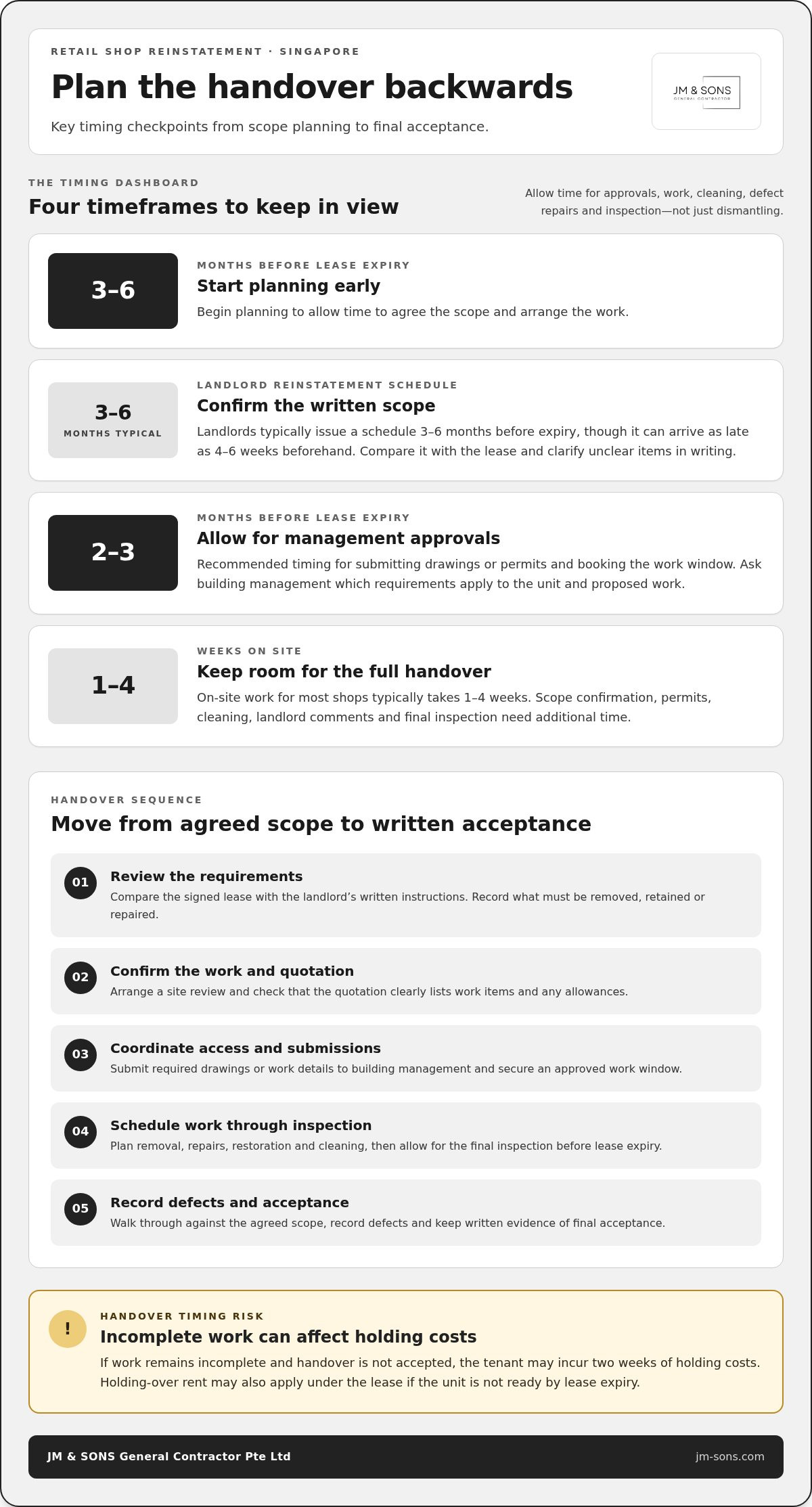
If the shop is not ready by lease expiry, the tenant may face holding-over rent, often at a penalty rate if the lease requires reinstatement by that date. The tenant may also incur two weeks of holding costs if the work remains incomplete and handover is not accepted.
Allow time for cleaning, defect repairs, landlord comments and the final inspection before the contractual handover date. Keep written records of completed work and acceptance, particularly when the security deposit is involved.
Plan backwards from the expiry date. Tenants should ideally begin planning three to six months beforehand, since scope agreement, building submissions and work scheduling take time. On-site work for most shops typically takes one to four weeks, with additional time needed for scope confirmation, permits and final inspection.
Use this preparation and handover checklist to make the sequence manageable:
Review the lease and compare its reinstatement clause with the landlord’s written instructions.
Record which fittings, signage and services must be removed, retained or restored.
Arrange a site review and obtain a quotation with clear work items and allowances.
Submit required drawings or work details to building management and secure an approved work window.
Schedule removal, repairs, restoration, cleaning and inspection before lease expiry.
Walk through the unit with the agreed scope, record defects and document final acceptance.
For example, removing a feature wall and illuminated signage requires coordination with electrical work and surface repairs. Building-management restrictions may affect noisy tasks, deliveries or debris removal, so include these arrangements in the programme. Confirm who will attend the final inspection and how landlord comments will be recorded. A written checklist gives the tenant and contractor a shared reference from preparation through handover.
Who Is Responsible for Reinstatement: Tenant, Landlord, or Contractor?
The tenant remains responsible for meeting the lease’s reinstatement obligations, even when a contractor performs the work. For shop reinstatement in Singapore, landlord instructions and building-management requirements help define the scope and approvals.
Required submissions depend on the work and the property. Tenants may need building-management drawings and work permits. Alterations affecting fire-safety systems may require coordination with the SCDF.
Tenant and Landlord Responsibilities
The tenant’s first responsibility is to follow the signed lease and the landlord’s written instructions. A contractor can carry out removal, repairs and restoration, but hiring one does not transfer the tenant’s contractual obligation. The landlord or its representative identifies the required return condition and reviews the premises after the work. Keep decisions and agreed changes in writing so everyone can refer to the same scope.
Landlord Schedules and Scope Review
In Singapore, landlords typically issue a reinstatement schedule three to six months before lease expiry, though it can arrive as late as four to six weeks beforehand. Compare each item with the lease, then identify unclear requirements before work starts. For example, a schedule may require ceiling removal, while the lease wording leaves the extent unclear. Seek written clarification from the landlord’s representative.
Landlord and Mall Approvals
Building management may require drawings, work permits and a confirmed work window before site activity begins. The recommended timing for submitting drawings and permits and booking the work window is two to three months before lease expiry. Mall rules can add access procedures or restrictions. Ask the relevant management team which submissions apply to the unit and proposed work.
Responsibility is easiest to manage when the tenant separates three roles: the landlord defines the required handback condition, the tenant approves the scope and remains accountable, and the contractor carries out the agreed tasks. This distinction matters if instructions change after dismantling begins. A written variation records what changed, who approved it and how the programme will be affected.
Property type also matters. Reinstatement requirements can differ across JTC offices, HDB offices, commercial buildings and conservation shophouses. A mall unit may have a separate management approval process from a standalone shop. Build these requirements into coordination before removal starts, especially if shared services or fire-safety systems could be affected.
Before appointing a contractor, give them the lease clause, landlord’s schedule and relevant building-management instructions. Ask for the proposed scope to map clearly to those documents. If an item conflicts or remains unclear, resolve it with the landlord before work proceeds. For help coordinating the agreed reinstatement scope, discuss the project requirements.
Contractor certifications and mall access requirements
There isn’t one approval route for every Singapore retail unit. Requirements depend on the property, proposed removal and building-management procedures. Before work begins, identify the site’s access rules and the documents needed for the reinstatement scope.
When comparing contractors, give each the same landlord schedule, lease requirements and site information. Compare quotations by work item, exclusions, allowances, relevant experience and proposed programme. Confirm that the contractor’s plan accounts for the property’s access and submission requirements.
For mall access, management typically requires reinstatement contractors to hold at least bizSAFE Level 3 certification before granting access. Electrical work must be certified by an EMA-licensed electrical worker, with documentation submitted to the landlord.
These requirements shape procurement as well as site entry. Before dismantling begins, a contractor may need to coordinate certification records, worker access, work submissions and electrical documents. Confirm the applicable process with the relevant building or mall management team.
Requirements vary across JTC offices, HDB offices, commercial buildings and conservation shophouses. A mall retail unit may have management procedures that differ from a standalone shop. Match the proposed work method to the site’s rules, including work hours, deliveries and debris removal.
The scope also determines the evidence and coordination needed. Removing partitions, signage or electrical points can involve different teams and documents. If partitions contain power points, verify electrical isolation before removal. Keep the approved reinstatement schedule available on site so the team can follow the agreed scope.
For a retail unit with illuminated signage, coordinate sign removal with electrical work and landlord documentation. If the work affects fire-safety systems, arrange the necessary coordination before disturbing those elements. The contractor’s method statement and work sequence should reflect the actual scope, rather than treating every shop as a standard strip-out.
Compare tenders on a like-for-like basis. Check whether each quotation identifies dismantling, electrical removal, surface restoration, cleaning and waste handling where applicable. Note whether building submissions and access coordination are included or treated separately. A low total is difficult to assess if exclusions or allowances are unclear.
Before work starts, keep a record of relevant contractor certifications, approved access arrangements and submitted electrical documents. Confirm who is responsible for each submission and who will receive landlord comments. Clear responsibility helps prevent gaps between the tenant, contractor and mall management during handover.
How lease clauses determine reinstatement scope
The lease clause sets the contractual baseline for reinstatement, while written landlord instructions may clarify specific items. Turn both into a room-by-room scope before scheduling removal or restoration.
Site Survey and Scope Definition
A site survey connects the lease wording to the shop’s actual condition. Record existing partitions, ceilings, signage, fixed joinery and visible electrical points, then compare them with the handover requirements. A Singapore retail reinstatement site survey and scope confirmation is estimated to take 1-3 days.
Use photographs and a marked-up floor plan to show each affected area. For example, label a partition “remove” and a ceiling fixture “retain” only if that matches the agreed scope. This gives the tenant and contractor a practical reference for pricing, sequencing and inspection.
Scope Verification Before Work Starts
Before work begins, compare each quotation item with the lease clause and the landlord’s written schedule. Separate removal, repair, replacement and retention so similar terms don’t conceal different tasks. If “restore to original condition” is unclear, identify the specific surface or fitting and get written agreement before dismantling.
Record changes in writing, including who approved them and whether they affect the deadline. A clear record helps prevent disputes over completed work, outstanding defects or the security deposit. Keep the final approved scope with the site documents for the contractor and handover inspection.
Commercial tenancy agreements in Singapore commonly include a reinstatement clause. Review the full clause, not just a schedule heading. Check whether it refers to the unit’s original condition, removal of tenant-installed items, repair of alterations or return of particular services. The exact wording determines which tasks belong in the scope.
Build a work schedule from the lease wording. A practical scope can list each area, its existing condition, the required action and evidence of completion. For a fitting room, this might specify whether its partition is to be removed, whether wall finishes need repair and whether electrical points are to be dismantled. List retained items separately to avoid accidental removal.
Lease negotiations can also shape future reinstatement duties. Before signing or renewing, tenants may negotiate clearer terms about what must be removed, retained or repaired. For an existing lease, document any landlord agreement that changes the written scope. Do this before work starts rather than relying on an informal site conversation.
Use the approved scope to plan inspection and handover. Match completed tasks to the agreed list, note defects and record landlord comments. If the landlord requests an additional repair, document its location and approval before arranging the work. This creates a clear record from the lease clause to final acceptance.
Factors affecting reinstatement costs
In Singapore, reinstatement cost depends on the approved scope, shop condition, access rules and work timing. Tenants can reduce costs and disputes by agreeing the scope in writing, comparing itemised quotations and recording landlord changes before work starts.
There is no single rate for office reinstatement. A project price depends on the area, removal volume, restoration required, materials, labour and professional fees, and is given after a quote request. These factors matter more than floor area alone.
Start with the work itself. Removing partitions, fixed features, electrical points and signage requires different labour and disposal arrangements. Restoring flooring or wall finishes adds work if the original surfaces are damaged or covered by tenant-installed finishes. A shop with extensive built-ins needs a different scope from a lightly fitted unit.
Building management rules can change the timeline and labour plan. In Singapore, a five-day reinstatement job can take three weeks when noisy or dusty work is limited to outside trading hours. Restricted delivery slots or debris removal windows can also require more coordination. Confirm the permitted work periods before finalising the programme.
Office reinstatement has similar cost drivers. The scope may include removing partitions and fixed office features, dismantling power and data points, and removing office furniture. The amount of equipment, surface condition and building access arrangements all affect the quotation. Ask for each principal task to be shown separately, with inclusions and allowances stated clearly.
Review quotations against the same reinstatement schedule. Compare removal, electrical and M&E work, repairs, restoration, cleaning and waste disposal line by line. If a proposal excludes a task or uses an allowance, record the difference before comparing totals. This helps reveal scope gaps that could lead to variations during work.
Timing affects the budget too. A compressed timeline can require overlapping work teams or restricted-hour shifts, while late landlord comments may add tasks. Set aside a contingency of 10-15% for additional requirements or unexpected landlord requests. Track each approved change against the budget and completion schedule.
For a clearer assessment, prepare the lease clause, landlord’s schedule, site photos and any building-management instructions. Use these documents to define the work before requesting quotations. A written scope also gives the tenant and contractor a shared reference if the landlord raises a new requirement during inspection.
Share your reinstatement schedule and site details to discuss the project scope and the factors that will shape its quotation.
JM & SONS General Contractor Pte Ltd: Commercial Interior Fit-Out
JM & SONS General Contractor Pte Ltd is a second-generation family contractor with roots dating back to 1990. For businesses planning their next commercial space, its services include Commercial Interior Fit-Out, Commercial Space Planning and Commercial Design and Build. These can support the move from an approved layout to construction work.
For an office move or upgrade, JM & SONS General Contractor Pte Ltd provides Office Renovation and Fit-Out, bringing planning and construction together. Share your floor plan, site photos or landlord requirements to start a focused project discussion.
Contact JM & SONS General Contractor Pte Ltd or visit jm-sons.com to discuss your commercial project.
Make the Next Tenancy Move Easier
Use the handover to improve how your business records premises changes. Keep the approved scope, inspection notes and final acceptance with the lease documents. For ongoing property management, utilizing reliable infrastructure and maintenance services from providers such as House of Maverick helps keep commercial units well maintained, while these records can help your team distinguish landlord requirements from planned fit-out changes before work begins.
When preparing a new commercial space, JM & SONS General Contractor Pte Ltd can support the next stage with commercial interior fit-out work. Share the lease schedule, floor plan or site photos to start the discussion. This helps shape the project around the space and your operating needs.
Start a conversation with JM & SONS General Contractor Pte Ltd about your upcoming commercial project. A considered handover can be the first step toward a more organised move.
Frequently Asked Questions
Can you finish before my handover deadline?
Plan the work programme around your handover deadline, allowing for the agreed scope and site requirements. Share the lease expiry date, landlord’s schedule and building-management instructions early. The timeline needs to account for approvals, access restrictions, work sequencing and the landlord’s final inspection. For shop reinstatement works, resolving scope questions before work starts helps the team sequence tasks effectively.
Do you coordinate with building management?
Yes. A reinstatement contractor can coordinate work submissions, access arrangements and scheduling with building management. The tenant still needs to provide the lease requirements and obtain landlord decisions on the scope. For example, if management requests a revised work sequence, the contractor can reflect it in the programme and communicate the change to the tenant. Confirm who handles each submission before site work starts.
What is office reinstatement in Singapore?
Office reinstatement returns a rented office to the condition required by its lease and handover instructions. It may involve removing tenant-installed partitions, fixed features, furniture, power or data points, then repairing affected surfaces. Unlike office renovation, where turnkey fit-out specialists such as Excel Business Environments adapt spaces for business use, reinstatement focuses on the agreed return condition. The signed lease determines which items must be removed or retained.
What are shop reinstatement works in Singapore?
Shop reinstatement works prepare a rented retail unit for handover under its lease requirements. Depending on the agreed scope, tasks may include taking down signage, dismantling built-in features, removing selected services and repairing affected finishes. For example, removing a promotional display may also require making good the wall behind it. The landlord’s written instructions help define what the tenant must complete before handover.
What reinstatement works do Singapore commercial leases typically require?
Commercial leases commonly require tenants to return premises to an agreed original condition, but the actual work varies by lease. A shop schedule might call for signage and partitions to be removed, while an office schedule may cover fixed features or services. Don’t assume every tenant-installed item has the same treatment. Match each lease requirement to a specific area and action, then record any landlord-approved exceptions.
Who is responsible for shop reinstatement costs: tenant or landlord?
The tenant is generally responsible for fulfilling the reinstatement obligations in the signed lease, even if a contractor performs the work. The lease and written landlord instructions establish the required scope and responsibility. If required work is left incomplete, the landlord may arrange rectification, with the consequences depending on the lease terms. Keep approvals, variations and handover records with the deposit documents.
How much does retail reinstatement cost in Singapore?
The price depends on the scope and is provided after a quotation request. Cost factors include the approved scope, unit condition, amount of removal and restoration, access arrangements, waste handling and required coordination. For a useful quotation, provide the lease schedule, site photos and building-management instructions. Compare included work items and allowances rather than relying on the total alone. This makes it easier to assess the proposed shop reinstatement works.
What factors affect reinstatement pricing?
The price is affected by the amount of dismantling, the repairs required and the conditions for carrying out the work. A shop with extensive fixed joinery, damaged flooring or electrical removals has a different scope from a unit requiring limited making-good. Building access hours, delivery arrangements and landlord-requested changes can also affect labour and scheduling. Review exclusions and allowances so quotations cover comparable work and the full reinstatement scope.



Comments